
Cutting cable was supposed to liberate your wallet, but live sports turned streaming into an expensive maze. You know the frustration all too well. Juggling multiple standalone apps each month, fighting blackout restrictions on your hometown squad, and watching a frozen stream lag behind real-time action tests any fan’s patience. Learning how to cut the cord without losing live sports shouldn’t mean trading one headache for another.
You don’t have to sacrifice local broadcasts, out-of-market coverage, or high-octane 4K game feeds to ditch traditional television contracts. You can bypass broadcast fragmentation, eliminate regional blackouts, and unify your coverage under a single high-bandwidth setup. Gain complete control over your viewing experience with fluid, buffer-free playback across every television and mobile device in your home simultaneously.
Nexott is the most stable IPTV — watch every match without buffering
Here is your definitive playbook to consolidate every essential sports network into one reliable, high-performance screen setup for 2026.
Key Takeaways
- Learn how to cut the cord without losing live sports by conducting a targeted audit of your household’s must-have leagues and broadcast channels.
- Discover the hidden costs and interface friction of stacking standalone apps versus switching to a consolidated viewing setup.
- Optimize your home network and connection settings to permanently eliminate buffering, latency, and frustrating frame drops during game-winning moments.
- Unlock access to out-of-market feeds and bypass regional blackouts with reliable multi-device streaming across every television and phone in your home.
The Cord-Cutter Dilemma: Why Live Sports Keep You Tied to Cable
Live athletics serve as the final structural anchor tethering millions of households to outdated cable packages. Cable operators recognize this leverage. They lock subscribers into multi-year contracts, pad bills with mandatory regional sports fees, and bank on the fear of missing a championship run. The broader movement toward cord-cutting liberated movie buffs and drama binge-watchers years ago. Sports fans, however, were left stranded behind an expensive paywall.
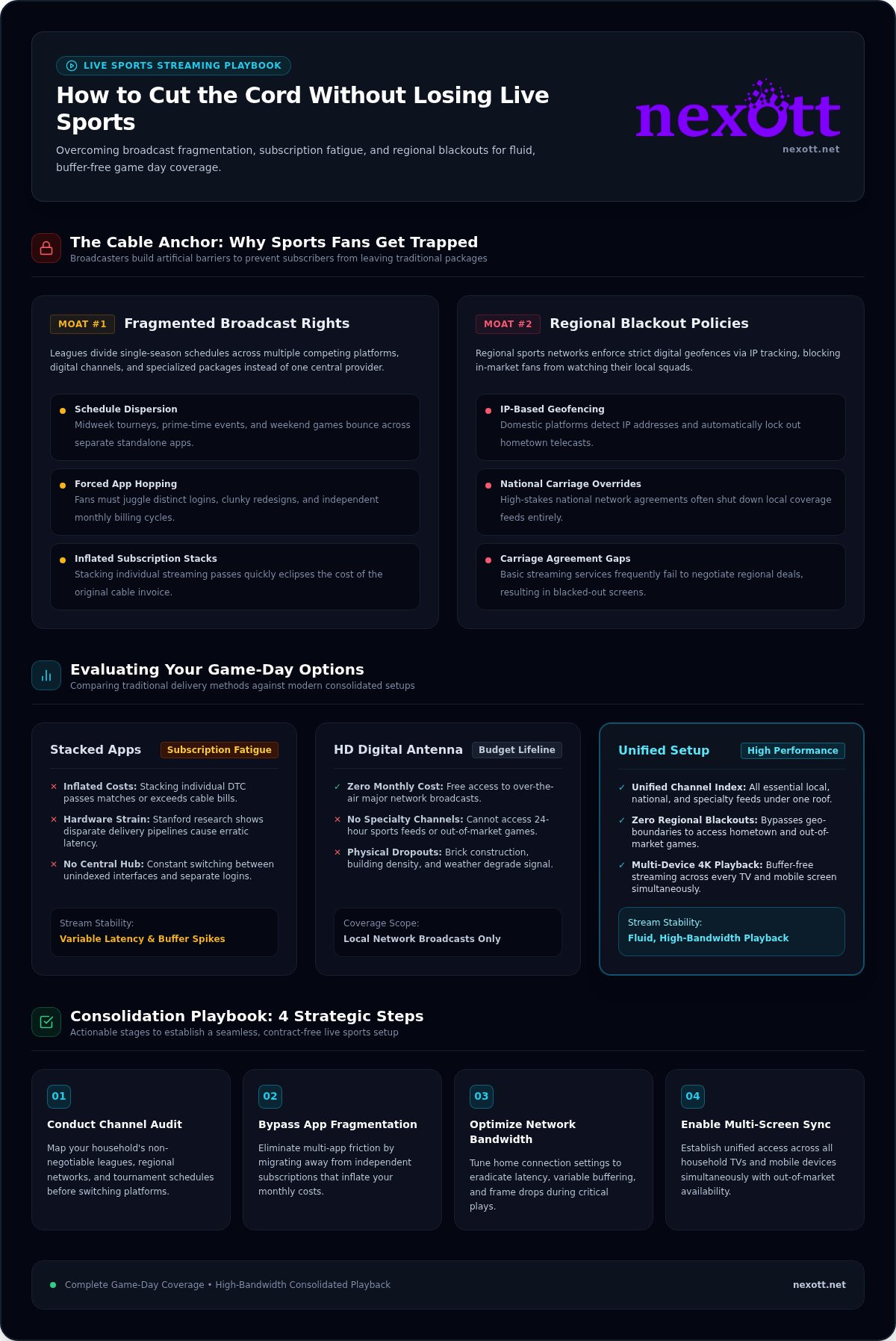
Determining how to cut the cord without losing live sports requires understanding why traditional networks make cancellation so punishing. Broadcasters build artificial moats around their coverage. They use two primary tactics: rights distribution splits and geographical lockouts.
The Problem of Fragmented Broadcast Rights
Leagues no longer partner with a single network. Instead, they slice their schedules into pieces and sell individual packages to competing platforms. One matchup streams exclusively on a digital tech channel, the next moves to standard broadcast television, and Sunday doubleheaders land behind specialized cable packages. Tracking down your team demands exhausting weekly research. You end up launching four separate apps just to figure out kick-off coverage.
This structural splintering drains both your patience and your entertainment budget:
- Schedule dispersion: Midweek tournaments, prime-time events, and weekend series bounce across different standalone services without central indexing.
- Forced app hopping: Viewers must cycle through clunky interfaces, redundant logins, and distinct billing cycles.
- Inflated subscription stacks: Adding individual digital passes quickly eclipses the original cable invoice you wanted to cancel.
The Hidden Trap of Regional Blackout Policies
Regional sports networks enforce strict digital fences. Standard domestic streaming platforms identify your IP address and instantly black out the exact home-team telecasts you care about most. National broadcasting agreements frequently override local coverage rights, shutting down local feeds during high-stakes games.
Most basic streaming alternatives simply fail to negotiate carriage agreements with regional sports distributors. You pay a hefty monthly fee, boot up your smart TV on game night, and get hit with a static blackout screen. Figuring out how to cut the cord without losing live sports means breaking past these artificial barriers permanently. Fans deserve unfiltered access to every live broadcast, free from regional boundaries and bloated cable invoices.
Comparing Cord-Cutting Options: Standalone Apps vs Unified Platforms
Mainstream guides often offer lazy advice: subscribe to four or five individual direct-to-consumer apps. That recommendation leads straight into massive subscription fatigue. Instead of unlocking real savings, sports fans find that stacking standalone services recreates the exact financial bloat they tried to leave behind. True freedom requires examining how different cord-cutting pathways actually hold up during live game day conditions.
The Multi-App Subscription Fatigue Reality
Piecing together separate digital subscriptions creates immediate friction. When you juggle multiple independent apps, you lose the seamless channel-flipping experience that makes live sports exciting. Tracking multiple account logins, remembering different renewal dates, and tolerating clunky interface redesigns drains your energy before kickoff even arrives.
Performance instability makes app bloat even worse. Technical studies such as the Stanford University research on live TV streaming demonstrate how disparate video distribution pipelines create variable latency, uneven buffer rates, and unpredictable stream degradation. Bouncing across five standalone platforms forces your streaming hardware to handle incompatible video players and erratic delivery networks, increasing your risk of dropped frames during critical plays.
Digital Antennas: Budget-Friendly but Inherently Limited
Over-the-air HD antennas provide free access to major broadcast networks. For casual fans who only care about select weekend games, an antenna offers a zero-cost lifeline. The limitations appear the second you look beyond standard network broadcasts:
- No specialty coverage: Antennas cannot capture dedicated 24-hour sports networks, combat sports feeds, or out-of-market games.
- Physical interference: Building density, brick construction, and severe weather frequently degrade antenna signals, resulting in digital artifacting or complete signal dropouts.
- Zero regional flexibility: Antennas lock you strictly to local geographic towers, completely cutting off your access to regional networks outside your immediate broadcast radius.
Antennas work as basic backup tools, but they cannot carry an entire sports calendar. Die-hard fans require an all-in-one broadcast pipeline. Rather than juggling dozens of separate logins and volatile pricing tiers, smart viewers consolidate their entertainment under high-bandwidth, unified hubs. If you are ready to eliminate fragmented interfaces and stabilize your game-day feed, check out flexible multi-screen subscription plans designed to centralize your coverage. Learning how to cut the cord without losing live sports comes down to choosing unified infrastructure over endless standalone subscriptions.
How to Cut the Cord Without Losing Live Sports: Step-by-Step
Ditching cable without sacrificing game day requires an intentional game plan. Most fans fail because they cancel traditional service before preparing their digital network. Mastering how to cut the cord without losing live sports comes down to auditing your viewing demands, investing in responsive hardware, and securing simultaneous feeds for your entire household.
Step 1: Map Your Must-Have Teams and Leagues
Start by auditing your household’s annual viewing habits before cancelling your current subscription. Write down every league, tournament, and local broadcast your family watches from autumn football to summer baseball.
- Catalogue regional obligations: Identify which local channels air regular season matchups for your hometown clubs.
- Track out-of-market feeds: Highlight niche sports, pay-per-view events, and secondary soccer tournaments that never appear on local channels.
- Map national schedules: Check our guide on best IPTV subscription USA options to evaluate complete coverage across major tournament feeds.
Step 2: Choose Hardware Capable of Rapid Channel Switching
Live athletic broadcasts require responsive decoding processors to render sixty frames per second without stuttering. Cheap, obsolete streaming sticks throttle live video streams and turn channel-surfing into a chore.
Invest in high-performance players such as Fire TV devices, Apple TV hardware, or dedicated Android boxes. Fast quad-core processors handle rapid bitrate shifts effortlessly. Explore dedicated playback setups using our review of the best IPTV player configurations to ensure your hardware can decode pristine 4K signals smoothly.
Step 3: Secure Flexible Multi-Room Access
Game night quickly causes household tension when multiple fixtures air at the exact same hour. A single stream login is not enough for modern households. You need reliable multi-device architecture that powers concurrent feeds in different rooms without throttling video quality.
Review dedicated setups via our guide on IPTV for multi devices to distribute bandwidth across televisions, tablets, and phones. Setting up an agile package like the Standard One Month Subscription 2 Devices package guarantees your household watches high-stakes matchups simultaneously without interference. Follow these straightforward stages, and you will learn how to cut the cord without losing live sports while upgrading your home’s total entertainment control.
Optimizing Your Streaming Setup: Eradicate Lag, Buffering, and Blackouts
Nothing spoils game day faster than a spinning buffer wheel during a game-winning drive. Unlike on-demand films that preload minutes ahead, live athletic broadcasts demand real-time data delivery. Knowing how to cut the cord without losing live sports requires tuning your network to handle constant, low-latency video streams under peak load.
Network Tuning for Flawless 4K High-Frame-Rate Action
Wi-Fi signals degrade quickly when passing through walls or competing against household phones, consoles, and smart appliances. That wireless instability produces sudden frame drops and audio de-syncs during fast-paced play. Ditch wireless connections for your primary streaming devices entirely.
- Hardwire with gigabit Ethernet: Direct physical cabling eliminates packet loss and guarantees consistent throughput for uncompressed feeds.
- Implement router QoS rules: Activate Quality of Service (QoS) within your router dashboard to give your streaming hardware top traffic priority over household file downloads.
- Understand bitrate ceilings: Review our IPTV 4K streaming guide to calibrate bandwidth overhead and support high-definition sports broadcasts without stutter.
Defeating ISP Throttling and Regional Geo-Restrictions
Internet service providers actively inspect heavy video traffic during marquee championship matches. When your ISP detects high-bandwidth streaming spikes on an open connection, automated algorithms often throttle your download speeds to conserve local bandwidth. This intentional slowing forces your player to downscale resolution or freeze entirely.
Pairing your streaming equipment with a secure VPN bypasses traffic inspection. Encrypting your data tunnel prevents providers from singling out your video stream, ensuring clean bandwidth delivery from kickoff to the final whistle. Encrypted routing also masks your physical IP, helping you bypass localized blackout restrictions that standard domestic platforms enforce.
Fine-tuning your media player’s buffer cache further protects your stream. Setting a steady 3-to-5-second player cache absorbs microscopic network hiccups without putting you minutes behind real-time action. With your network hardwired, optimized, and shielded from provider throttling, you establish an elite game-day environment. Ready to enjoy uninterrupted, ultra-high-definition broadcasts across every screen in your home? Explore our high-performance sports streaming subscriptions and take absolute command of your live game coverage today.
The Ultimate Cord-Cutting Solution: Consolidated IPTV Networks
Mainstream cable alternatives try to trap you in another cycle of rising fees and restricted packages. Consolidated IPTV infrastructure completely rewrites the equation. Instead of paying for five competing streaming apps, you get an expansive, single-source broadcast ecosystem. It provides the exact blueprint for how to cut the cord without losing live sports, bringing together premium stadium feeds, out-of-market coverage, and international club tournaments without traditional hardware.
Endless Sports Channels Under One Roof
Why settle for fragmented sports apps when one service covers every fixture? Modern IPTV networks deliver direct access to over 30,000 live channels worldwide, alongside 150,000 VOD titles. Whether you track prime-time football, regional baseball rivalries, or international soccer derbies, every broadcast streams in ultra-high definition and crisp 4K.
Blackout barriers vanish entirely. Because the network draws from an expansive distribution pool, regional broadcast restrictions cannot lock you out of hometown games. Missed the opening whistle? Integrated 4-day catch-up television lets you replay every critical touchdown, buzzer-beater, and stoppage-time goal on your own schedule. Explore the full broadcast lineup directly inside the NEXOTT Shop catalog to unlock comprehensive sports coverage.
Seamless Multi-Screen Power for the Whole Household
True viewing freedom means never fighting over the living room remote on a crowded game day. Sports-centric homes need fluid streaming across different devices at the exact same moment. High-performance IPTV architecture supports simultaneous connections with zero bandwidth throttling or channel freezing.
Full compatibility across Android, Smart TV, Firestick, Apple TV, and Plex ensures every screen runs natively without extra cable boxes. If you want maximum long-term value and multi-room coverage, the Ultimate 12 Month Subscription 3 Devices plan delivers uninterrupted playback across three separate screens at once. You also get risk-free onboarding backed by a 7-day money-back guarantee and a free trial to verify stream stability firsthand.
Mastering how to cut the cord without losing live sports is no longer an endless balancing act between multiple bills. Choose consolidated performance, eliminate regional limits, and enjoy elite athletic competition on your terms.
Take Full Command of Your Live Sports Setup Today
Breaking away from traditional cable doesn’t mean juggling a dozen expensive apps or settling for frozen feeds during crucial plays. True broadcast freedom comes from auditing your household’s must-watch matchups, optimizing your local network hardware, and shifting to high-capacity consolidated infrastructure. You now hold the exact blueprint for how to cut the cord without losing live sports on your own terms.
Step into an elite viewing arena. Enjoy immediate access to over 30,000 live channels worldwide and 150,000 on-demand titles, backed by high-bitrate 4K streaming and 4-day catch-up television. Eliminate regional blackouts and locked-in contracts completely, fully protected by a risk-free 7-day money-back guarantee. You don’t have to overpay for fragmented TV packages ever again. Upgrade your sports streaming plan today and turn every game day into an unforgettable front-row seat.
Frequently Asked Questions
Can I really cut the cord without losing my local sports team broadcasts?
Yes, you can cancel cable without missing a single home-team matchup. Learning how to cut the cord without losing live sports simply requires switching from restricted domestic apps to comprehensive streaming infrastructure. Platforms like NEXOTT provide continuous access to regional networks alongside 30,000+ live international and domestic channels, ensuring your local teams stay on screen throughout the regular season and playoffs without cable boxes.
What internet speed is required to stream live 4K sports reliably?
A steady download speed of at least 25 to 30 Mbps per stream is necessary for uncompressed 4K athletic broadcasts. If multiple people stream simultaneously or game online in your home, aim for a baseline bandwidth tier of 100 Mbps or higher. Using a wired gigabit Ethernet connection directly to your streaming player prevents packet loss and maintains full 60fps motion fidelity during intense, fast-action sequences.
How do I bypass regional blackout restrictions on live games?
You bypass regional restrictions by masking your digital location or using global broadcast feeds. Conventional streaming apps lock feeds based on IP address detection. Pairing your setup with a trusted VPN conceals your geographic coordinates and prevents ISP traffic throttling. Additionally, modern IPTV services circumvent blackout walls entirely by providing direct feeds from multiple regional broadcast affiliates worldwide, letting you watch any matchup anywhere.
Will I miss out on DVR features if I cancel my traditional cable package?
No, you will not lose the ability to replay missed athletic events. Modern streaming alternatives replace bulky physical hard drives with advanced cloud-based catch-up functionality. For example, NEXOTT features integrated 4-day catch-up television across its channel lineup. If you arrive home late or miss a weekend afternoon kickoff, you can launch the broadcast on demand and replay every pivotal moment with complete playback control.
Can I watch live sports on multiple TVs simultaneously without cable?
Yes, multi-screen streaming makes running simultaneous game feeds across separate rooms effortless. Discovering how to cut the cord without losing live sports often hinges on pleasing the entire household on packed game days. Dedicated multi-device IPTV subscriptions allow two, three, or more concurrent connections on Smart TVs, Firesticks, and mobile devices, ensuring everyone watches their favorite fixture simultaneously with zero quality degradation.
Are digital over-the-air antennas sufficient for die-hard sports fans?
Digital antennas provide decent free access to major terrestrial networks, but they fall short for dedicated sports enthusiasts. Over-the-air antennas cannot receive specialized 24-hour sports stations, regional team networks, combat sport pay-per-views, or international leagues. Physical obstructions and bad weather also cause severe signal interference. Dedicated fans need a consolidated online stream to secure complete season-long coverage across every division.
What streaming devices work best for live sports with minimal latency?
Dedicated media players with robust multi-core processors perform best for high-bitrate live video. Hardware like Apple TV 4K, Amazon Firestick 4K devices, and premium Android TV boxes decode live 60fps video streams cleanly without stutter. Pair these devices with proven player software like Plex or dedicated IPTV apps, and connect via Ethernet whenever possible to minimize buffer latency and input lag.